Centralize control of labels and product information

Retail price labeling. Deployed to fit every branch.

Promotional prices, assortment changes, and product information must be accurately displayed in every store – on electronic shelf labels and printed price tags.

Separate control creates duplicate maintenance, discrepancies, and extra effort in the market. With neeyo, retail companies centrally manage labels, product information, and process documents and distribute them by store, brand, and output format. Hardware-independent. Integrable into existing system landscapes.

ESL-independent

Paper + digital

Across subsidiaries

ERPPIM-compliant

Digital price tagging in retail with neeyo

Where distributed control becomes operationally noticeable in trade

When price changes don't translate smoothly into everyday life

In retail, the problem isn't the individual work step itself, but the lack of connection between them. As soon as price logic, product information, formats, and rollout run separately, changes become slower, store processes more complex, and information at the shelf inconsistent.

Price changes arrive too late at the stores

If adjustments run through multiple systems, approvals, or manual intermediate steps, it takes too long for new prices to become effective where they are intended to be visible.

The register, the till, and the label are diverging.

Price, product name, description, and design must consistently align. Without joint control, deviations will arise that are immediately noticeable in daily operations.

Paper and digital editions create duplicate care.

If electronic shelf labels and paper-based price tags are managed separately, the maintenance effort increases unnecessarily.

Special formats make changes unnecessarily complicated

Action labels, larger formats, and further outputs take time if format logic and deployment are not managed centrally.

Recurring process documents are running alongside.

Pallet labels, delivery notes, order forms, and other standardized documents waste valuable time when data sources, templates, and output are organized separately.

Vendor-specific ESL setups restrict control

When software and hardware are conceived as a package, dependence, price pressure, and conversion costs increase.

How neeyo brings retail processes together

Centrally manage prices, labels, and expenses

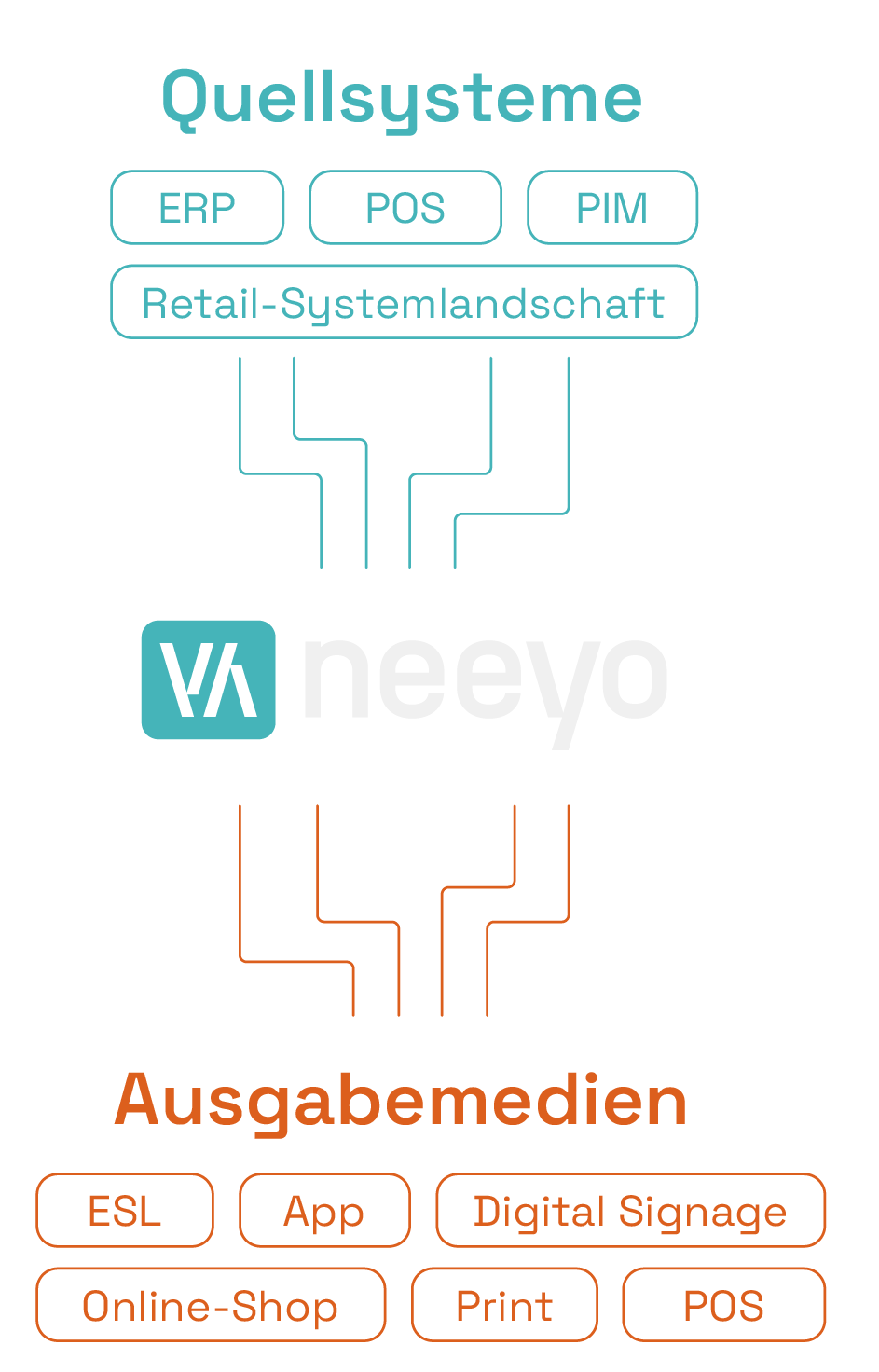
neeyo picks up where data sources, price labels, and distribution channels converge. Instead of maintaining prices, product information, layouts, and documents separately for each output channel, a central control point is created between core systems and distribution. This allows changes to be rolled out more consistently, different formats to be managed effectively, and existing system landscapes to be supplemented strategically.

Before

Changes are initiated system-wide or manually.

Product data, label content, and layouts each follow their own logic depending on the output path.

ESL software and hardware are conceived as a package. This increases dependency and price pressure.

Electronic shelf labels and paper-based labels run side-by-side.

Special formats generate additional effort.

Recurring documents run in separate processes.

Control ends at the level of individual clients, brands, or branch structures.

Core systems and output media are loosely coupled.

What do you mean

Changes are centrally triggered and rolled out across all branches.

Prices, content, and design are controlled by a common software logic.

Control is achieved via a central software interface. This keeps the ESL landscape more flexible.

Digital and printed price tags can be operated from the same control point.

Different output and display formats remain controllably manageable.

Templates, building blocks, data sources, and targeting interlock.

Pricing, labeling, and output processes remain centrally controllable across multiple tenants and brands.

Existing system landscapes are supplemented rather than replaced.

Fields of application in practice

Where central control works in trade

Central control shows its greatest value where price changes, store processes, and standardized expenses come together in daily business. This is precisely where it becomes apparent whether changes take effect quickly, information remains consistent, and teams are relieved in their operational day-to-day work.

Roll out price changes across all branches

New prices and label content can be initiated centrally and rolled out consistently across branches.

Control electronic and printed price labeling in parallel

ESL and paper price tags can be operated together, instead of ending up in separate systems.

Keep action labels and special formats manageable

Even larger ad formats and deviating layouts remain controllably manageable, without having to set up new manual loops for every special case.

Keep product information consistent across output media

Not only prices, but also product names, descriptions, and languages remain consistent across formats and outputs.

Provide standardized logistics and process documents

Pallet slips, delivery notes, order forms, and other recurring documents can be generated in a standardized way and populated with current data.

How centrally controlled label printing relieves branches in daily business is shown by the example of SPAR Austria.

Example of practice

Retail deployment

SPAR Austria Group

At SPAR Austria, neeyo is used for digital label printing. Print data is processed centrally, labels are generated automatically, and output to the desired store printers. This allows for more efficient price adjustments, eases the daily workload in stores, and provides controlled management of different formats.
That creates:

  • more efficient price adjustments
  • higher productivity in the stores
  • dynamic format adjustments up to A3 and A4 advertising formats

Make retail processes centrally controllable

We'll show you how neeyo centrally consolidates price changes, product data, and label printing—tailored to your system landscape and your daily retail operations.