Invoices, tariff changes, meter readings
Customer communication for municipal utilities and energy providers. Centrally managed.
Consumption data, prices, deadlines, and mandatory information come from different systems. With neeyo, energy suppliers and municipal utilities manage templates, approvals, and channels centrally – from the invoice to outage notifications.
Invoices & Reminders
Rate Changes
Omnichannel
Revision-proof
ERP/CRM-compatible
Where Decentralized Control Creates Friction at Utilities
When Customer Communication Becomes an Operational Burden
Many inquiries don’t start with customer service—they begin even earlier: with scattered data, templates, approvals, channels, and manual processes. As a result, changes take longer, information becomes inconsistent, and coordination becomes time-consuming.
Invoices are sent to customer service
If consumption data, prices, fees, discounts, and required disclosures leave questions unanswered, the burden shifts directly to customer service.
Changes to rates, prices, and fees are subject to a consultation process
New prices, contract information, regulatory notices, and effective dates must be accurately implemented across all content, approvals, and channels.
Payment processes generate follow-up questions
Bills, payment reminders, and collection notices contain a lot of sensitive information: amount, due date, usage data, and customer information. Even minor ambiguities can quickly lead to follow-up questions.
Meter readings create recurring work
Meter readings, digital feedback, and the transfer to specialist and ERP systems often do not mesh seamlessly. This leads to manual effort and delayed processing.
Case communication requires clear status updates
Connection requests, service disruptions, appointments, and individual service cases can quickly lead to follow-up inquiries if the status and next steps remain unclear.
Channels diverge
Letters, emails, portals, archives, and e-invoices often follow their own logic. Without centralized control, version conflicts and rework occur.
How neeyo Brings People Together
A central logic for content, approvals, and distribution
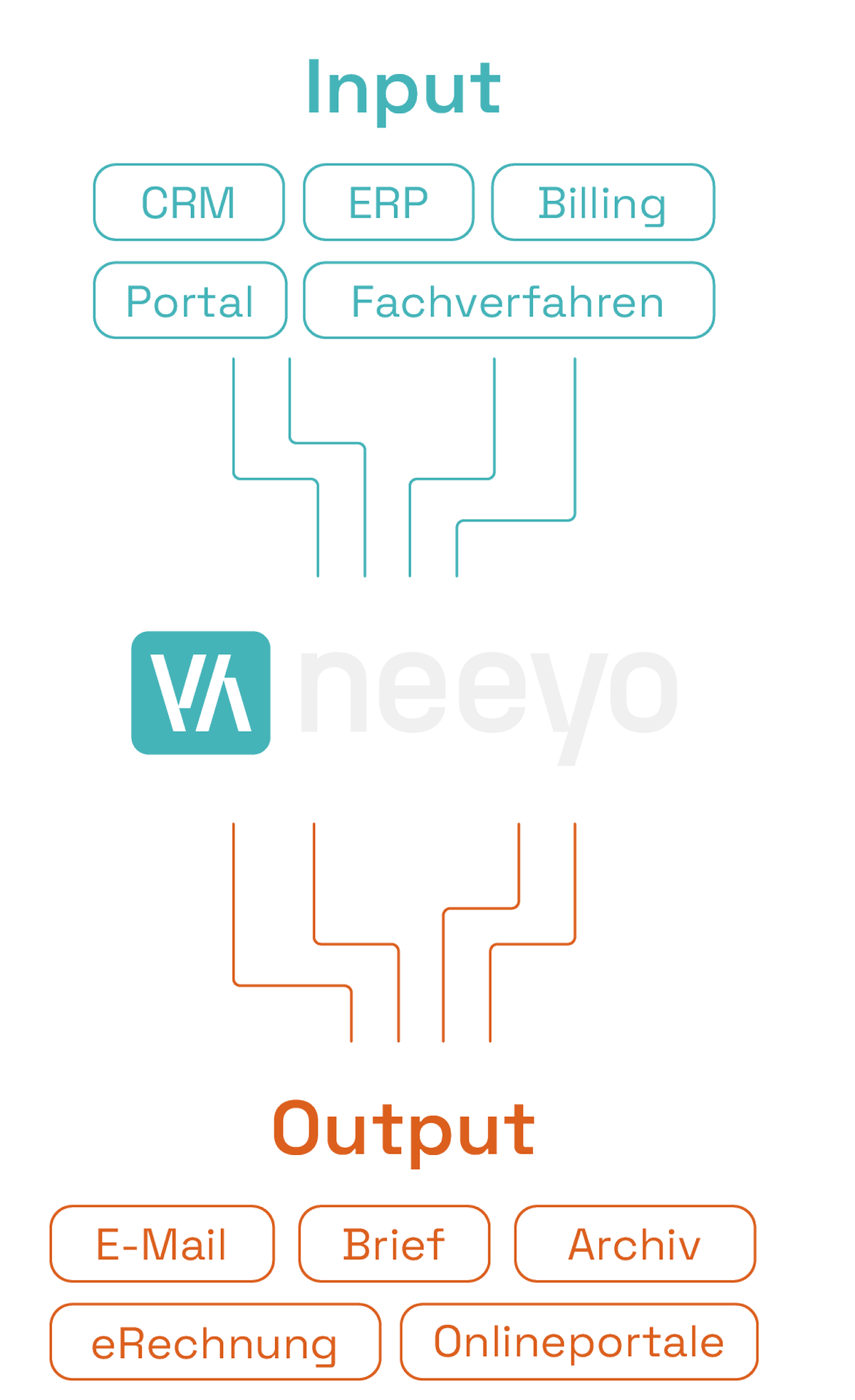
neeyo integrates document-based customer communication into a unified management framework: content, templates, approvals, delivery, and archiving are seamlessly linked within a controlled process.
Existing ERP, CRM, billing, portal, and archiving systems are specifically integrated rather than replaced. This enables departments to implement changes more quickly, maintain consistent information, and manage critical communications in a traceable manner.
Before
Content, templates, and required information are scattered throughout the system.
Changes trigger coordination between the department, IT, and other roles.
Channels follow their own process logic.
Mass runs and individual cases are handled separately.
Existing systems provide data, but communication remains distributed.
Meter reading cards cause data discontinuities and require manual effort
What do you mean
Content is managed, approved, and reused centrally.
Changes are implemented in a controlled manner and take effect across all relevant documents.
Mail, email, the portal, e-invoices, and the archive remain consistently linked.
Standardized and personalized communication come together within a common framework.
Existing ERP, CRM, billing, portal, and archiving systems are specifically integrated rather than replaced.
A seamless digital process connects the customer portal, validity checks, and ERP—reducing effort and enhancing the customer experience.
Fields of application in practice
From Billing to Archiving: Managing Communication Effectively
The greatest impact is achieved where large amounts of information, deadlines, and channels converge: with invoices, rate information, payment reminders, utility connections, meter readings, and outage notifications. neeyo links these touchpoints into a unified communication framework—one that is transparent across systems, departments, and channels.
From the Occasion to Clear Communication
1.
Communicate the contract start date
Consistently generate welcome letters, contract confirmations, and onboarding information using existing data and templates.
2.
Manage Digital Meter Reading
Control meter reading requests, digital responses, plausibility checks, and data transfer to existing ERP systems in a controlled manner.
3.
Provide Invoices in an Easy-to-Understand Format
Create and review annual and usage statements in a structured manner, and make them accessible across all channels.
4.
Communicate price and rate changes
Centrally maintain, release, and distribute tariff texts, price components, mandatory information, and cutoff dates.
5.
Safely process payments
Generate installment payments, payment reminders, and dunning notices based on rules — from mass runs to individual cases.
6.
Provide case-related information
Communicate status updates, technical notes, deadlines, and service-critical information on a case-by-case basis.
7.
Archive documents traceably
Document delivery, versions, releases, and storage cleanly.
Example of practice
Retail deployment
Uelzen Municipal Utilities
Stadtwerke Uelzen manages over 15 document types centrally with neeyo – including annual invoices, reminders, price adjustments, welcome letters, and campaign mailings. Clearly structured, easier-to-understand invoices reduce inquiries to customer service and make document production more flexible.
That creates:
- More understandable annual and consumption statements
- fewer customer service inquiries
- More independence in document production
- more flexible implementation of price adjustments and other document types