
Digital customer communication for banks
Account statements, reports and contract documents. Centrally controlled.
High volumes. Fixed deadlines. Ongoing changes. Advanced core and specialist systems. Even a simple adjustment can affect numerous document variants, customer groups, language versions, and permissions.
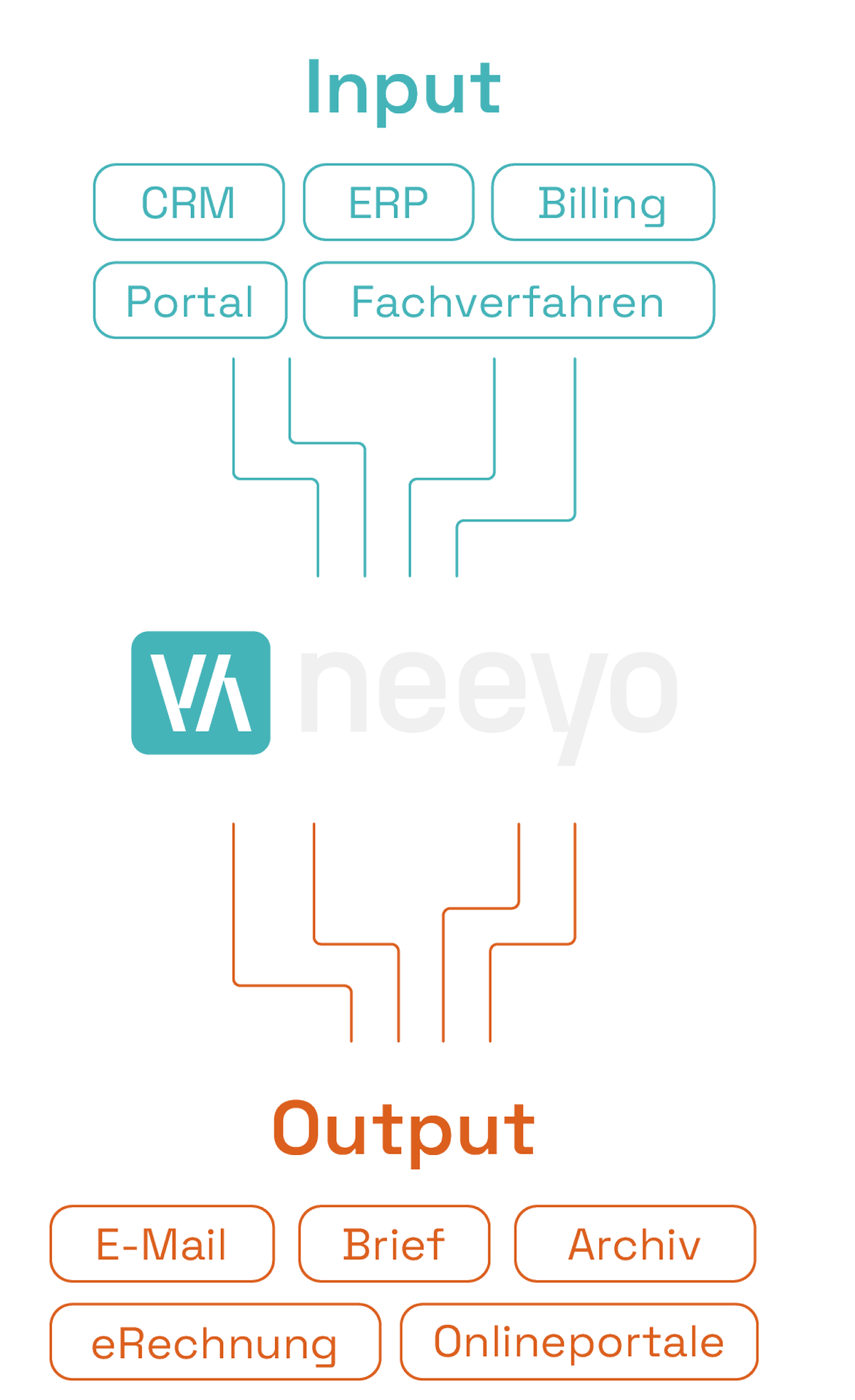
With neeyo, you bring data, content, approvals, and playback into a common logic. This makes complex customer communication manageable centrally – across established systems, document variants, and output paths.
Cloud or On-Premises. Self-hosted or Managed Service.
Account, deposit account and contract communication
Many documents. A valid status.
Many inquiries don’t start with customer service—they begin even earlier: with scattered data, templates, approvals, channels, and manual processes. As a result, changes take longer, information becomes inconsistent, and coordination becomes time-consuming.
High volumes.
Fixed deadlines.
Bank statements, tax documents and reports are regularly generated in large quantities. At the same time, each document is based on individual customer, account or deposit data.
Advanced systems. Specific expertise.
Core and specialized systems, special solutions, and interfaces have evolved over the years. Adjustments often require a deep understanding of the system and specialized resources.
Many variations.
Several languages.
Products, customer groups, and language regions generate different document versions. If content exists in multiple versions, the effort increases with each change.
New requirements.
Long implementation times.
New documents, technical adjustments, or regulatory changes impact across templates, systems, and responsibilities. If IT resources are required for this, additional coordination and waiting times arise.
Regulatory requirements. Inspections and approvals.
Changes to customer information undergo professional and regulatory audits. With each adjustment, the following matters are important: which version has been approved, where it is being used, and what has been changed?
Digital mailboxes.
Physical shipping.
Documents are delivered digitally or physically. Creation, delivery, shipment, tracking, and archiving are distributed across several process steps.
Central control
Core systems remain. Communication is controllable.
neeyo connects account, deposit, and contract data with content, rules, permissions, and output paths in a common communication logic.
Before
Key dates and high volumes
Account statements, tax documents, and reports are generated in large quantities based on individual customer, account, and deposit data.
Grown systems
Account, deposit, and customer data come from different core and specialist systems. Adjustments require IT resources.
Document variants and language versions
Products, customer groups, and languages generate different document variants. Changes often affect multiple versions.
New requirements and approvals
Technical or regulatory changes affect documents, systems, and responsibilities. Approvals extend the implementation process.
Separate output processes
Digital delivery, print, tracking, and archiving follow different process chains.
Data security and operating model
Customer and financial data place high demands on data control, infrastructure, and operations.
What do you mean
Generate documents based on a regular pattern
Individual customer, account and deposit data are regularly fed into document creation – even in high volumes.
Core systems provide data. Communication remains controllable.
Core and specialist systems remain the leading data sources. Content, rules, authorisations and output paths are connected in a common logic.
Central change logic
Content and rules are centrally controlled and used for the required document and language variants.
Track changes in a comprehensible way
Content, versions, and releases are managed in a unified logic. This ensures that everyone is clear about what is current and where it is being used.
Consistent output
Documentation, digital and physical presentation, tracking and archiving are intertwined.
Control over data and operations
Cloud or on-premises, self-managed or managed service – tailored to security requirements and existing IT strategy.
Use cases
Recurring reports. Individual customer cases.
Their customer communication ranges from milestone processes with high volumes to individual transactions. Data, checks, and approvals follow their own logic depending on the process.
Account, Depository & Client Reporting
Create and provide account statements, portfolio overviews, and investment reports based on individual customer and account data on a regular basis.
Tax and due date communication
He generates, provides, and passes on tax certificates and other milestone-related documents in structured form even with high volumes, integrating them into existing output processes.
Digital onboarding & Know Your Customer (KYC)
Integrate customer and document data for account opening and KYC into digital application, verification, and communication processes.
Contract communication
Use customer and application data already captured for contract documents and follow-up documents. Assemble content individually and integrate it into the further process.
Individual customer correspondence
Connect standardized content with individual details and integrate it into existing testing, approval, and output processes.