
Templates, rules, and dependencies are often only partially documented. Documents are compared manually, layouts are checked before releases, and changes are coordinated between business departments and IT.
Therefore, before AI analyzes, compares, or prepares work, it must be clear what task it is actually supposed to take on, and where expert decision-making and approval begin.
The crucial question is not where AI can be applied as much as possible, but which concrete task AI can reliably prepare – and which decision remains with humans.
The AI leverage is often in the inventory
Before a migration, system change, or major release, companies should first establish transparency:
- What templates are used?
- Which content is duplicated or nearly identical?
- What technical differences are necessary?
- What rules are documented?
- What knowledge is held only by individual employees?
If this overview is missing, existing complexity is often carried over into the new system. Specialists spend a lot of time on review, manual comparisons, and quality assurance. Decisions about cleansing or migration are based more on assumptions than on reliable information.
In this situation, AI can help make the inventory visible, comparable, and assessable. Based on this, the specialist department decides: Which variants are still needed? What can be merged? Which content needs to be revised or deliberately not included?
What AI can take over – and what it can't
Tasks that are repetitive, clearly defined, and can be checked using defined criteria are particularly suitable.
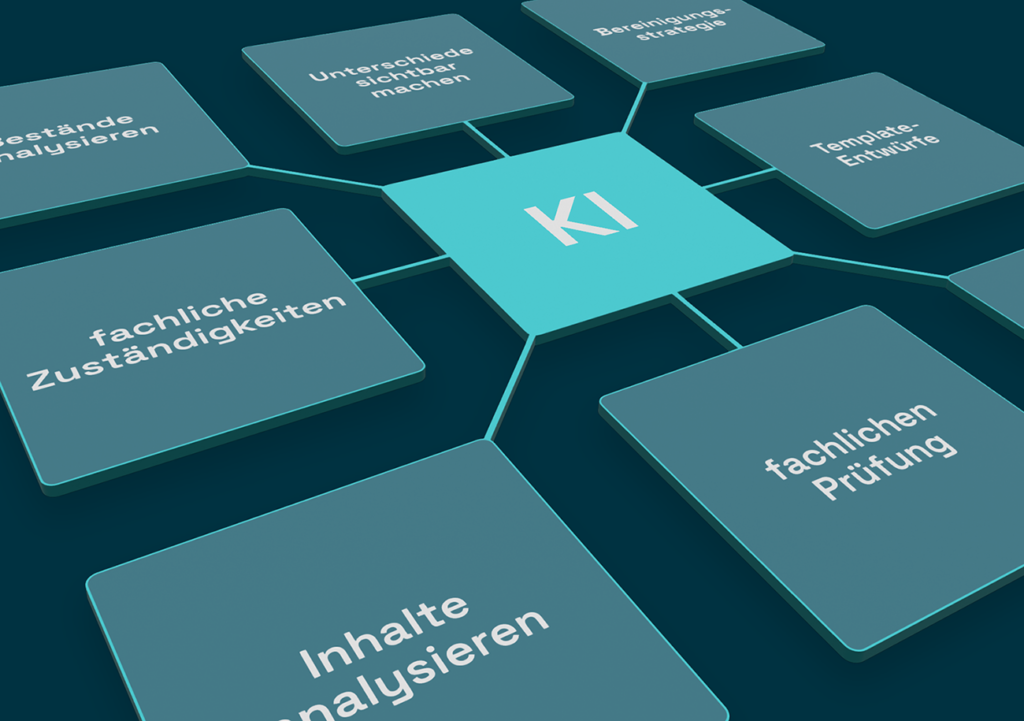
In CCM, this primarily affects three areas:
Analyze and structure
AI can capture, group, and mark possible duplicates in template inventories based on specific characteristics.
Compare and assign
AI can compare document versions, visualize differences, or prepare possible data relationships for a migration.
Check and prepare
AI can check for deviations from defined layout rules and content rules and prepare results for expert evaluation.
Depending on the task, AI supports in different ways: it structures inventories, compares versions, or prepares individual work steps within a clearly defined process. What matters is not how the technology used is named, but how the responsibility is distributed.
The AI prepares. The department sets the goal and rules, evaluates the result, and decides on release.
This division of labor is necessary because a plausible proposal is not automatically technically correct. Missing rules must not be replaced by assumptions. The specialist department decides which templates are reused, merged, or deleted. AI results must not be incorporated into binding customer communication without review.
AI is strong in preliminary work. Commitment only arises through expert review and approval.
How to turn a PDF template into an auditable template draft
The starting point is an existing PDF template and a corresponding data pattern. The AI analyzes the layout and structure of the template, matches it with the data, and prepares an initial draft template. This reduces the manual effort involved in capturing and recreating existing structures.
Subject-matter experts will then add specific rules, exceptions, and necessary adjustments. They will review the proposed assignments, correct them if necessary, and manage the further development of the template.
Before the draft moves to the next process step, the Hard Gate, a mandatory review and release stage. This procedure follows the Human-in-the-loop principle The AI prepares the work status; the technical evaluation, correction, and approval are carried out by the responsible employees. Only after this can the workflow continue.
The benefit lies in the clear division of labor. The AI takes on part of the preparatory analysis and setup work. The subject matter expert ensures that the result is technically correct and approved for further use.
7 Questions Before Implementing a CCM Task with AI
A high manual effort does not automatically make a task a suitable AI use case. What matters is whether it can be clearly described, processed with appropriate data, and reliably verified by experts.
- Is the task clearly described?
Not „AI in CCM,“ but for example: „Group templates by content similarity.“. - Does the task repeat itself in a similar pattern?
Comparable inputs and work steps are better suited for AI support than rare special cases. - Are suitable foundations in place?
Professionally valid documents, data, rules, or reference results are required. - Can the result be verified using clear criteria?
It must be recognizable when a proposal is correct, incomplete, or incorrect. - Are exceptions and uncertainties taken into account
Corrections, follow-up questions, and the rejection of a suggestion must be possible. - Is the responsibility clearly defined?
An AI-prepared result must be reviewed, corrected if necessary, and approved by a responsible person before further processing. - Can the result be integrated into the existing process?
After release, it must be clear where and how the result can be traced and further processed.
The AI Checklist for CCM Tasks (PDF) supports the structured classification of a specific use case. It shows which requirements are already met and which points should be examined more closely before implementation.
AI belongs in the process – not beside it
A suitable task alone is not enough. How the AI is integrated into the existing document process is also crucial. If data is transferred to separate tools, results are manually fed back, and approvals are documented elsewhere, new breaks are created instead of relief.
A robust process therefore connects task, input, intermediate result, professional review, and approval. Only then can AI preliminary work be comprehensibly transferred to the next process step.
Questions about data storage, model selection, and operating models remain important. However, they should be derived from the specific use case – not the other way around.
Conclusion: The specific use case is decisive
AI supports CCM where tasks are clearly defined, repeatable, and verifiable based on technical criteria. It can analyze inventories, highlight differences, and prepare individual work steps.
For this to become a robust process, appropriate data and rules must be in place, responsibilities must be clarified, and review and approval must be integrated into the workflow. AI does not replace these prerequisites.
Therefore, the crucial factor is not to automate as many steps as possible. For each task, it must be clear what the AI prepares, what is checked by humans, and how an approved result is further processed within the existing process.
Sources: ISO®, Information on the EU AI Act, Future of Life Institute